
Shouldn't the rear pressure bulkhead on a 747 be facing the other way to be able to handle more pressure. The pressure will be pushing the panels together instead of pushing them apart therefore handling more pressure.
$\begingroup$
$\endgroup$
0


New contributor
Stars is a new contributor to this site. Take care in asking for clarification, commenting, and answering.
Check out our Code of Conduct.
Add a comment
|
2 Answers
$\begingroup$
$\endgroup$
5
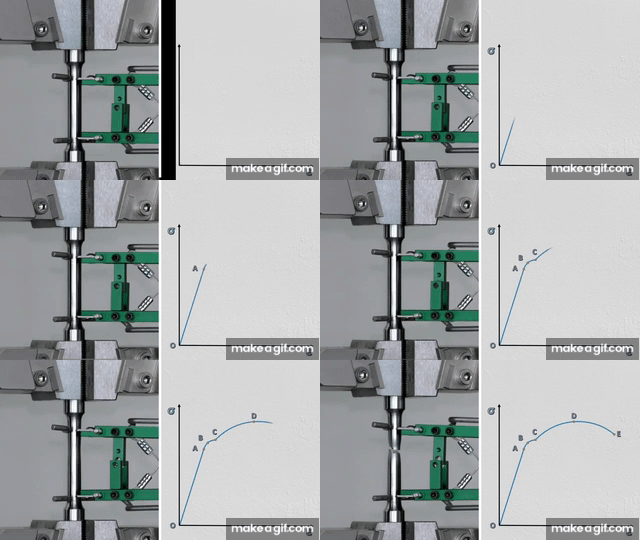
If you pull (apply tension to) a structural component (let's say a simple bar), when the load reaches a certain value the bar breaks:
However if you push (compress) that same bar, before breaking it will deform and, more or less suddenly, it will lose its ability to support the load. This phenomenon is called buckling:
Since buckling occurs at a level of load smaller than the breaking load, to avoid it the structure must be designed in a stronger (and therefore heavier) way.
As normally designed, bulkheads are stressed in tension: If they were designed in compression as you suggest, they should be designed to prevent not only rupture but buckling as well and they would be heavier.
So, if weight saving matters (and if it feasible) it is better to design a structure in tension instead of compression, just like the Inca did 😉

-
$\begingroup$ Oh come on! The Inca reference is totally bogus - show me how to build a rope-based bridge in compression, or a stone bridge in tension!? $\endgroup$MikeB– MikeB2025-12-03 09:50:59 +00:00Commented yesterday
-
3$\begingroup$ @MikeB: there's a smiley at the end of that sentence, relax. $\endgroup$sophit– sophit2025-12-03 10:19:19 +00:00Commented yesterday
-
$\begingroup$ @MikeB a rope-based bridge in compression – So, a tensegrity bridge? It provides strength against compression even when all components are under tension. $\endgroup$forest– forest2025-12-04 10:24:35 +00:00Commented 18 hours ago
-
$\begingroup$ Perhaps shaving foam cans where concave/convex are each better in the same environment for different reasons for a very cost-optimised solution are something to consider. $\endgroup$Andrew Morton– Andrew Morton2025-12-04 20:13:44 +00:00Commented 9 hours ago
-
$\begingroup$ A balloon is an good example; thin material that buckles almost instantly, but works excellently at containing pressure in tensile mode. $\endgroup$vidarlo– vidarlo2025-12-04 20:48:25 +00:00Commented 8 hours ago
$\begingroup$
$\endgroup$
1
This is a misconception. Unless you're building it out of stone or concrete, tension is better. Most metals and composites can withstand ~same or more force in tension than in compression, and they can buckle under compression unless stiffened. A concave shell works even unstiffened.
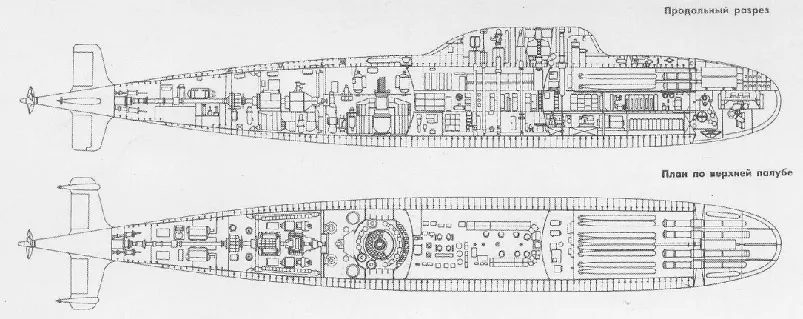
You can look at submarines for comparison, where loads are much greater, except in the opposite direction (pressure on the outside). While the hull has to be convex, the internal bulkheads are built flat or concave against the pressure.
Even the world's deepest-diving series production submarine has concave pressure bulkheads protecting its central "shelter compartment":
For aviation it's even more important to load it in tension, because the shell is very thin and prone to buckling.


-
2$\begingroup$ I think it would be good to further clarify that the situaton is reversed in the case of a submarine (more pressure on the outside) compared to an aircraft (more pressure on the inside), and that's why the bulkhead is 'aimed' the other way. $\endgroup$ROIMaison– ROIMaison2025-12-02 13:47:36 +00:00Commented 2 days ago